

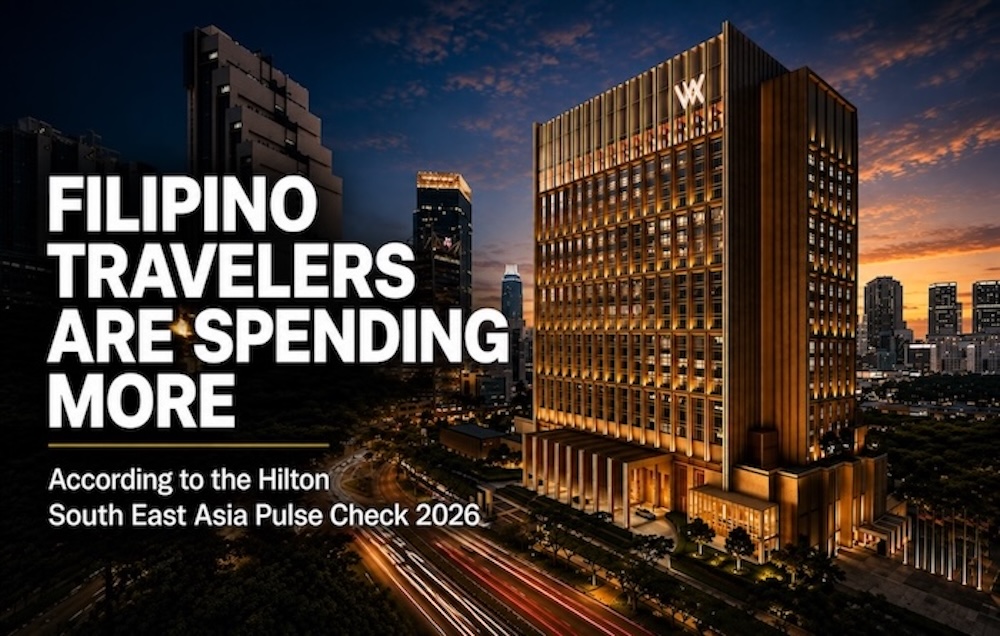
Hilton study finds 60% of Philippine travelers plan to spend more per trip, while 70% typically visit multiple destinations within a country
Filipino travelers are showing a strong appetite for longer, fuller and more experience-driven journeys across Southeast Asia, with more than half planning to increase their travel spending and explore new destinations in the region.
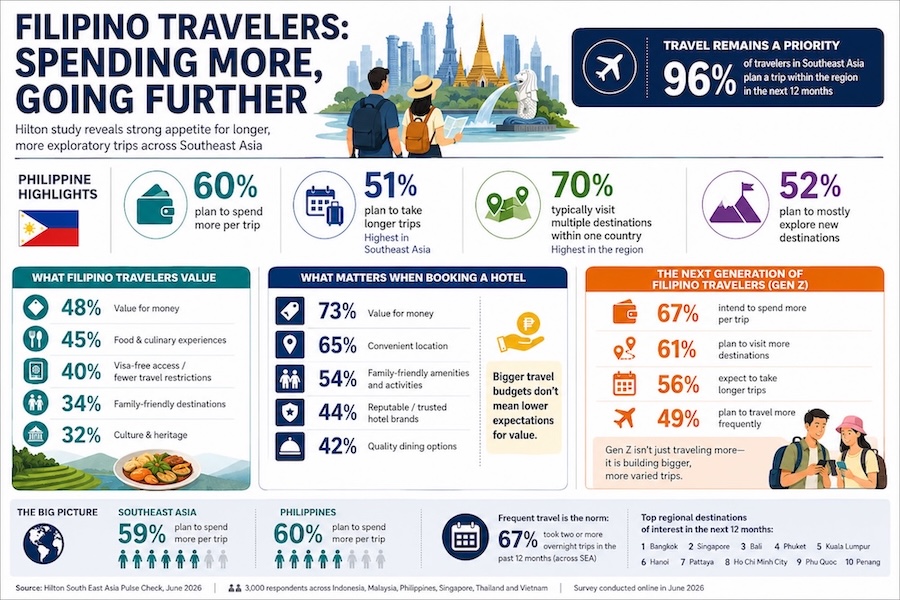
According to Hilton’s South East Asia Pulse Check, 60% of Philippines-based travelers plan to increase their budget per trip, while 51% intend to take longer trips—the highest proportion among the six Southeast Asian markets surveyed.
The study also found that 53% of Filipino travelers expect to visit more destinations per trip, while 38% plan to travel more frequently.
The findings point to a broader shift in Southeast Asian travel, where growth is increasingly being driven not simply by travelers taking more trips, but by their willingness to spend more on journeys they consider worthwhile.
Across the region, 59% of travelers plan to increase their spending per trip, compared with 50% who expect to visit more destinations per trip, 43% who plan to take more trips and 41% who anticipate longer stays. (Hilton Stories)
Filipinos show strongest appetite for exploration
The Philippine market stands out for its preference for fuller itineraries and new discoveries.
Seven in 10 Philippines-based travelers, or 70%, typically visit multiple cities or areas within a country during a single trip—the highest proportion among the markets surveyed. For future travel within Southeast Asia, 52% plan to mostly explore new destinations, while 43% expect to combine new places with familiar favorites.
Only 5% plan to mostly revisit destinations they have already experienced.
The preference for exploration is also reflected in the destinations Filipino travelers are considering. Their top 10 destinations of interest over the next 12 months are Singapore, Bangkok, Bali, Hanoi, Phuket, Ho Chi Minh City, Kuala Lumpur, Manila, Jakarta and Pattaya.
The findings suggest that the Filipino traveler is increasingly looking beyond a single destination, building trips around multiple experiences and places.
Bigger budgets, but value still matters
The willingness to spend more does not mean Filipino travelers are becoming less discerning.
Value for money remains the leading consideration when choosing a destination, cited by 48% of Philippines-based travelers, followed by food and culinary experiences at 45%.
Accessibility is also significant, with 40% citing visa-free access or fewer travel restrictions as an important factor in destination choice. Family-friendly destinations and cultural landmarks and heritage follow at 34% and 32%, respectively.
The same value-conscious behavior carries into hotel bookings.
For Philippine travelers, value for money is the top accommodation consideration at 73%, followed by convenient location at 65% and family-friendly amenities and activities at 54%. Reputable hotel brands and quality dining options were cited by 44% and 42%, respectively.
The figures suggest that travelers may be prepared to allocate more to travel, but expect the experience, convenience and amenities to justify the additional spend.
Gen Z emerges as a key growth market
Younger Filipino travelers are particularly bullish about travel.
Among Philippine Gen Z travelers, 67% intend to spend more per trip, while 61% plan to visit more destinations, 56% expect to take longer trips and 49% plan to travel more frequently.
Across Southeast Asia, Gen Z is similarly emerging as a major driver of travel growth, with 54% planning to travel more frequently, 58% intending to visit more destinations per trip and 47% expecting to take longer trips. Millennials, meanwhile, show the strongest intention to increase their spending, at 63%.
For the hospitality sector, the numbers point to a younger traveler who is not simply looking for more holidays, but for richer and more varied experiences from each journey.
Travel remains closely tied to celebrations
The Philippine market also differs from its Southeast Asian neighbors in what motivates travel.
According to the study, 52% of Philippines-based travelers travel to celebrate a personal milestone or special occasion, making the Philippines the only market surveyed where celebrations outweigh both the desire to escape and social media inspiration as the primary travel driver.
Destinations seen online or on social media inspire 45% of Filipino travelers, while promotional deals and discounts motivate 33%.
Food is another major part of the travel equation. Across the region, food ranks among the strongest travel experiences, while in the Philippines it is cited by 62% of travelers as a sought-after experience.
Social media still inspires; AI helps plan
Digital platforms continue to play a major role in shaping travel decisions.
Across Southeast Asia, social media influences where travelers go for 78% of respondents, compared with 63% for AI. Social media also has a stronger influence on activities and experiences, at 72%, versus 63% for AI.
When it comes to accommodation, however, the gap narrows, with social media influencing 67% and AI 61%.
YouTube and TikTok are the region’s leading travel inspiration platforms, cited by 75% and 71% of travelers, respectively. Among Gen Z, TikTok rises to 84%.
The findings indicate that while social media remains the primary source of inspiration, AI is increasingly becoming a planning companion as travelers move from discovering destinations to making actual accommodation and itinerary decisions.
Hilton recently introduced its Hilton AI Planner, a generative AI-powered digital concierge on Hilton.com designed to help travelers explore its portfolio, compare properties and amenities, and receive recommendations through a conversational interface.
Hotels become part of the travel experience
The study also highlights the expanding role of hotels in the overall journey.
Across Southeast Asia, value for money (67%) and location (59%) remain the leading considerations when booking accommodation, but quality dining (47%) and family-friendly amenities (45%) also rank highly.
For Philippine travelers, the emphasis on family-oriented facilities is even stronger, with 54% citing family-friendly amenities and activities as an important consideration.
For hotels, the findings reinforce the need to offer more than accommodation, as dining, convenience, family facilities and other on-property experiences increasingly contribute to the perceived value of a stay.
Hilton currently has 124 properties across Southeast Asia, with recent openings including Hilton Bangkok Suvarnabhumi Golf Resort & Spa, Hilton Quang Hanh Onsen Resort and Hilton Burau Bay Langkawi Resort. Upcoming openings include Conrad Phu Quoc, Hilton Phu Quoc and DoubleTree by Hilton Phu Quoc.
Hilton said the findings from the South East Asia Pulse Check will help inform its 2027 Trends Report, which will examine travel behaviors and trends expected to shape the region in the year ahead.
The South East Asia Pulse Check was conducted online in June 2026 among 3,000 respondents, with 500 respondents each from Indonesia, Malaysia, the Philippines, Singapore, Thailand and Vietnam. Respondents were segmented into Gen Z, Millennials, Gen X and Baby Boomers.


