

 Leechiu Property Consultants (LPC) sees continued pressure on arrivals through year-end, while shifting source markets underscore the need for easier connectivity
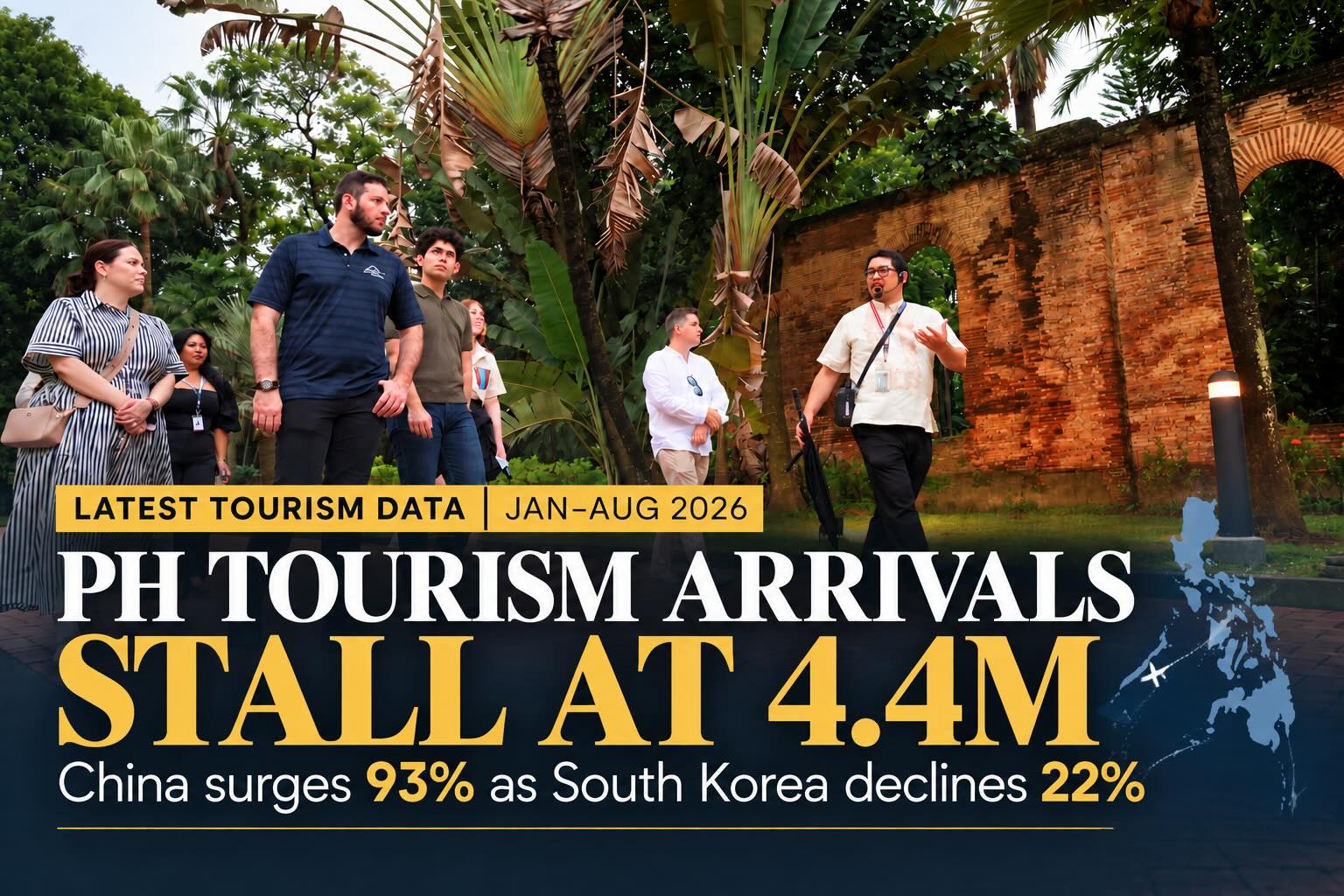
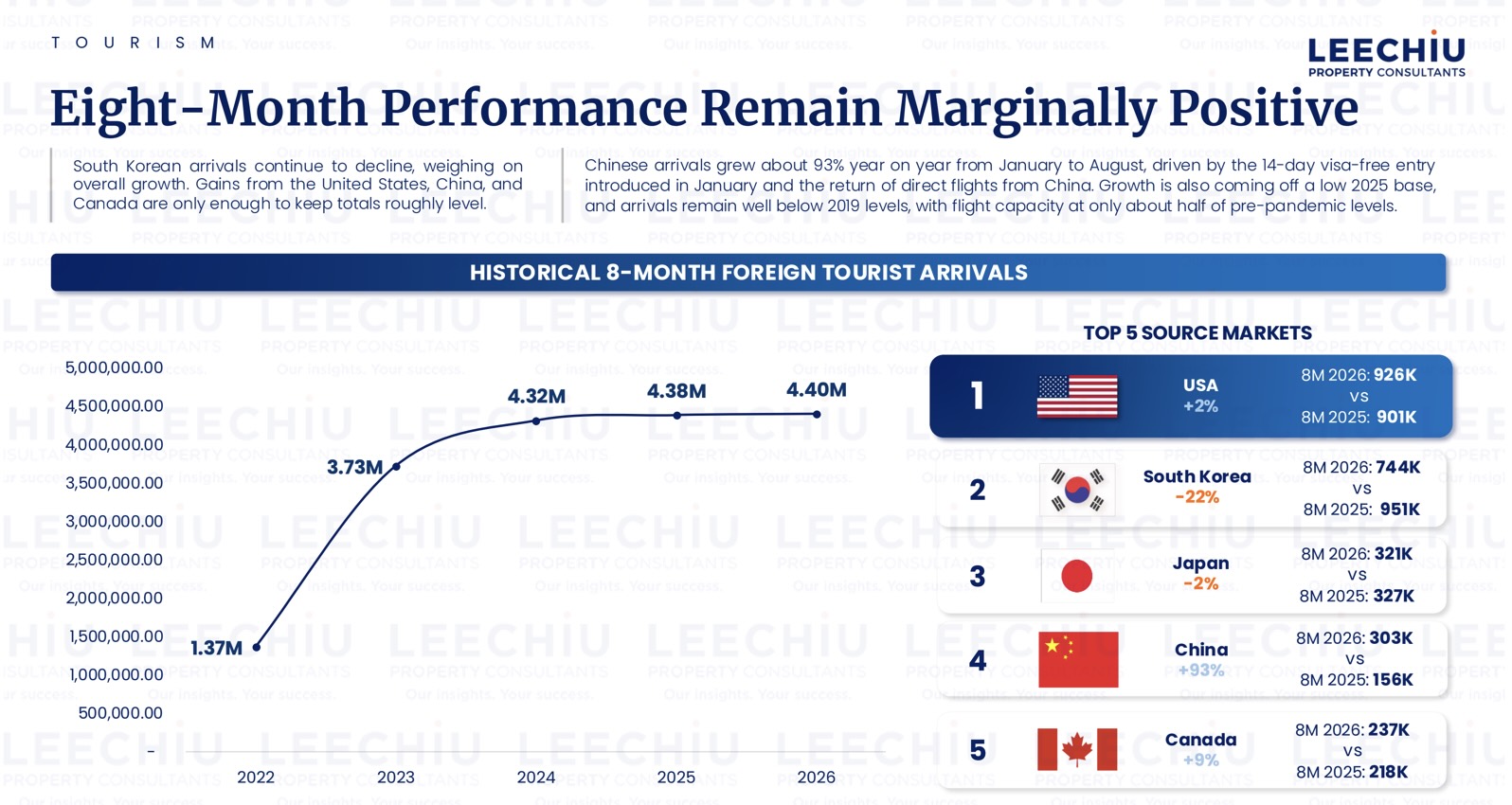
Makati City, 6 October 2026 — Foreign tourist arrivals to the Philippines reached approximately 4.4 million from January to August 2026, essentially flat against the 4.38 million recorded during the same period in 2025, as higher travel costs and weaker performance from key source markets tempered tourism growth.
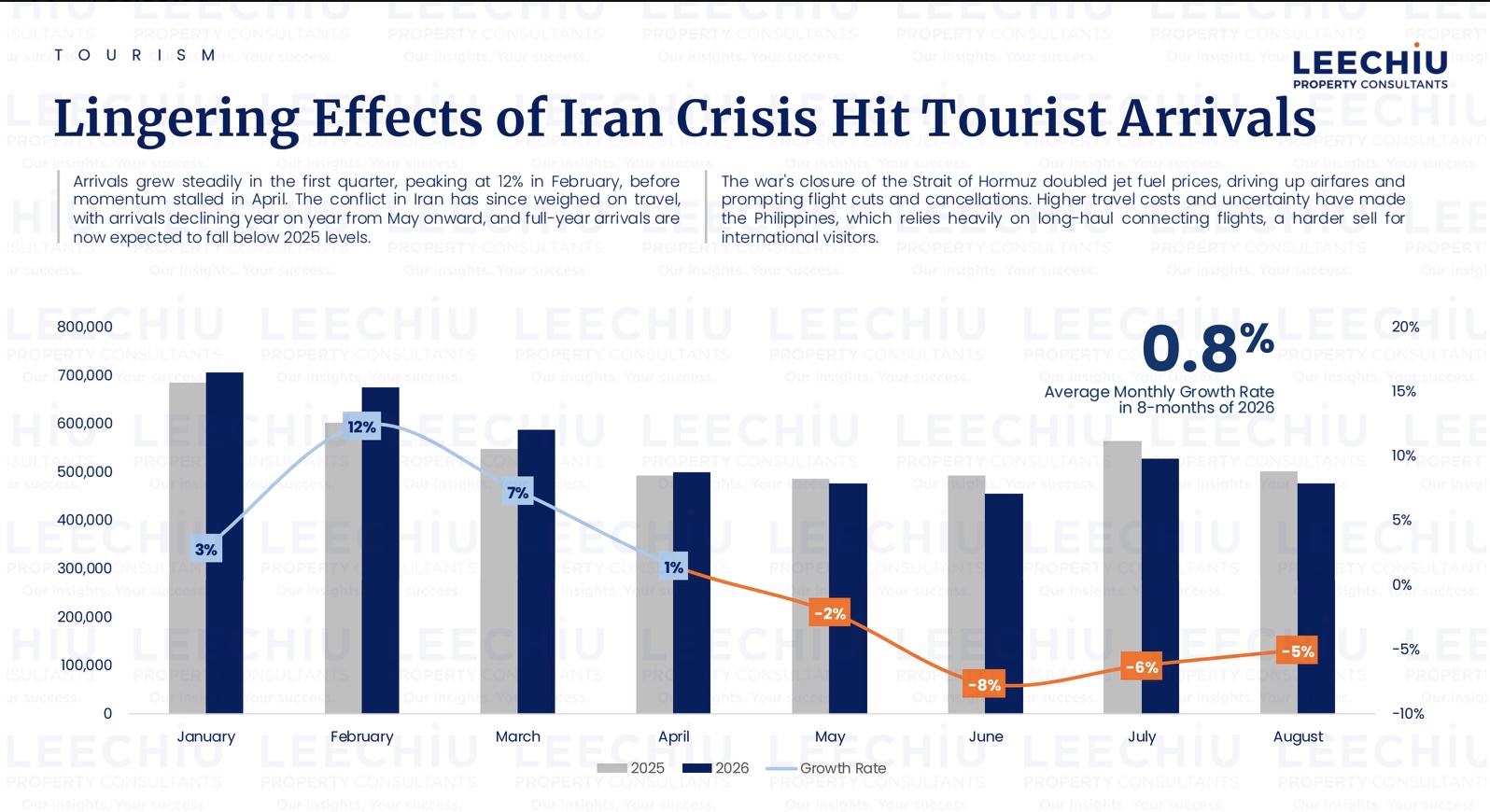
According to Department of Tourism (DOT) data cited by Leechiu Property Consultants (LPC), arrivals grew steadily during the first quarter, with year-on-year growth peaking at 12% in February. Momentum subsequently weakened, easing to 7% in March and 1% in April before turning negative from May onward.
Growth declined by 2% in May, 8% in June, 6% in July and 5% in August. The average monthly growth rate for the first eight months was just 0.8%.
LPC expects full-year international arrivals to fall below 2025 levels as higher fuel and travel costs continue to weigh on demand.
China emerges as a bright spot
Beneath the relatively flat headline figure, the country’s tourism source-market mix is changing significantly.
DOT data cited in the LPC analysis showed the United States remained the Philippines’ largest source market, with approximately 926,000 arrivals, up 2% from 901,000 during the same period last year.
South Korea followed with about 744,000 arrivals, down 22% from 951,000. Japan recorded approximately 321,000 arrivals, down 2% from 327,000.
Meanwhile, China posted the strongest growth among the major markets, with arrivals reaching about 303,000—up approximately 93% from 156,000 in the same period in 2025.
Canada also recorded growth, reaching approximately 237,000 arrivals, up 9%.
LPC noted that Chinese arrivals sustained growth of more than 50% every month from February, supported by the introduction of 14-day visa-free entry in January and the return of direct flights from China.
The growth, however, comes from a relatively low 2025 base. Chinese arrivals remain below 2019 levels, with flight capacity still at only about half of pre-pandemic levels.
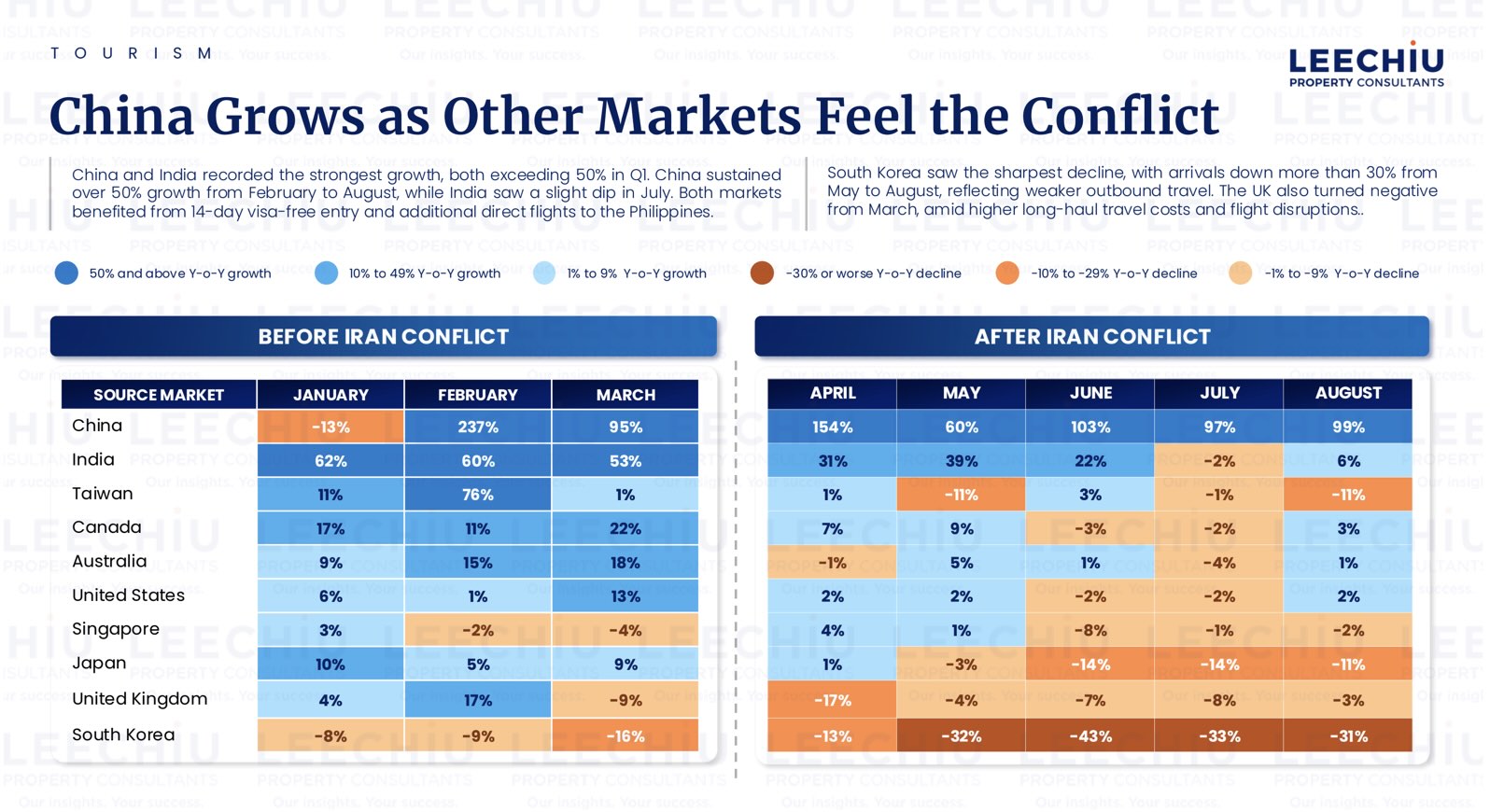
India has likewise shown strong potential, growing by more than 50% during the first quarter before moderating in July.
South Korea weighs on overall growth
South Korea’s sharp decline has become a significant drag on overall tourism performance.
LPC reported that Korean arrivals fell by more than 30% each month from May through August, reflecting weaker outbound travel.
Japan has been in negative territory since May, while the United Kingdom has recorded declines since March, as higher long-haul travel costs and flight disruptions affect demand.
The contrasting performance reinforces the importance of diversifying the Philippines’ tourism source markets while reducing the friction involved in traveling to the country.
Higher travel costs slow momentum
LPC’s analysis points to the impact of the Iran conflict and disruptions around the Strait of Hormuz as contributing factors to higher jet fuel prices, airfares and flight reductions.
For the Philippines, which relies heavily on long-haul and connecting flights, higher travel costs make the destination more difficult to sell in an increasingly price-sensitive market.
LPC expects these pressures to continue affecting international arrivals through the end of 2026.
Connectivity remains critical
For Adam Domingo, Senior Manager of Hotels, Tourism, and Leisure at Leechiu Property Consultants, the experience of China and India demonstrates the impact of reducing barriers to travel.
“Unless we change how we do tourism at a basic level, foreign arrivals are likely to stay near today’s levels into next year.”
Domingo pointed to the strong performance of China and India following measures that made travel to the Philippines easier.
“Where the Philippines made travel easier, through visa-free entry and additional direct flights, arrivals from both markets grew by more than 50% in the first quarter, and China has sustained that pace since February. Reducing travel friction produces results.”
He said the same principle applies to air connectivity.
LPC’s analysis points to destinations where tourism investment is already taking place but international access remains limited. Puerto Princesa, for example, has an international airport but currently lacks direct international routes that could help unlock its potential.
“Developers are betting on these places, but travelers cannot yet fly to them directly,” Domingo said.
He noted that introducing direct international routes could potentially be implemented more quickly than building or expanding airport infrastructure and could help stimulate arrivals sooner.

A closer look at domestic tourism
Domingo also called for a closer examination of domestic tourism, which he noted generates substantially more value than foreign tourism.
He specifically raised the relocation of turboprop operations from NAIA to Clark and its possible impact on island destinations dependent on these flights.
“Island destinations that depend on turboprops report that business is down. Is the relocation a factor? The industry needs the data to answer that,” he said.
A review, he added, would help determine what works best for travelers, resorts and the workers whose livelihoods depend on tourism.
Outlook: Flat arrivals, changing opportunities
Philippine tourism enters the final months of 2026 with international arrivals under pressure but with opportunities emerging in specific markets.
China’s strong recovery, India’s growth potential and the continued expansion of direct air links offer avenues for rebuilding international demand. At the same time, the steep decline in South Korean arrivals demonstrates how overall performance can be affected when a major source market weakens.
For LPC, the immediate priority is reducing travel friction through easier visa access, stronger international connectivity and better alignment between air access and tourism destinations.
The longer-term opportunity remains significant, but realizing it will require connectivity to keep pace with the country’s tourism ambitions.


